
How to Choose a Professional Security Consultant
Updated: 1 day ago
Table of Contents
Why Credentials and Licensing Matter Most
What to Look for in a Licensed and Insured Consultant
How to Verify Professional Credentials
Building Your Physical Security Risk Assessment Checklist
Key Items Every Assessment Should Cover
Evaluating Commercial Security Services and Local Presence
Range of Services and Emergency Response
Pricing Transparency and Written Estimates
Maintenance Contracts vs. Ad-Hoc Service
Access Control Integration and Tech Proficiency
Background Checks and On-Site Trust
ADA and Fire Code Compliance
Security Consultant Interview Questions to Ask
How to Score the Answers
What to Request Before You Sign
Hiring a Professional Institutional Locksmith for Churches
NFPA 80 Fire Door Inspection Requirements and Compliance
Access Control Integration and Maintenance Contracts
Frequently Asked Questions
Last Updated: September 12, 2026
Why Credentials and Licensing Matter Most
Knowing how to choose a professional security consultant starts with one filter: verifiable credentials. A security consultant is a specialist who assesses physical risks to a property and recommends practical fixes, from door hardware to access control. Virginia Security Concepts has built its practice on that consultative model, and we can tell you plainly that the credentials question separates serious firms from the rest.
What to Look for in a Licensed and Insured Consultant
Ask for proof of licensing and insurance before anything else. A legitimate consultant carries general liability coverage and, where required, a state license for locksmith or security work. Request a certificate of insurance directly from the insurer, not a photocopy from the consultant. Also confirm the technician who will actually visit your site, since the person who sells the job is not always the person who performs it.
How to Verify Professional Credentials
Verification takes minutes and saves months of regret. Check the license number against the state database, call the insurer to confirm coverage is active, and look for manufacturer certifications on the specific hardware you own. The U.S. Small Business Administration's guidance on hiring contractors outlines the same verification steps for any trade, and they apply here without modification.
Watch Out A common mistake is hiring on price alone and skipping verification. If an uninsured technician damages a door frame or is injured on your property, the liability lands on you, not them.
Building Your Physical Security Risk Assessment Checklist
A physical security risk assessment checklist is the working document that turns a vague worry into a prioritized repair list. Every credible assessment covers the same core ground, and you should expect a written report, not a verbal summary.
Key Items Every Assessment Should Cover
Exterior doors, frames, and hinges inspected for wear and forced-entry damage
Lock hardware inventoried by type and condition
Master key system mapped, including who holds which keys
Lighting and camera coverage mapped at entry points
Access control points tested, including electronic strikes and readers
Fire doors checked for proper closing and latching
Emergency egress routes confirmed clear and code-compliant
A thorough walkthrough typically takes time depending on building size. What most guides miss is documentation: without photos and a written report, you have no baseline for measuring whether anything improved.
Evaluating Commercial Security Services and Local Presence
A local physical office matters more than most buyers realize. When a lock fails on a Friday night, a firm with a nearby base and a stocked van responds in hours; a distant provider schedules you for next week. Ask directly about after-hours coverage and average response time, then get it in writing.
Range of Services and Emergency Response
The strongest commercial locksmith and consulting firms handle lock installation, rekeying, lock repair, deadbolt installation, panic bars, and key duplication in-house. Fragmented providers subcontract, which adds delay and blurs accountability when a door fails an inspection. Emergency lockout response deserves its own question: who answers the phone at 2 a.m., and how fast can a technician reach your address?
Pricing Transparency and Written Estimates
Demand a written estimate before work begins and a written invoice after. Line items should name parts, labor, and any service call fee. A firm that resists putting numbers on paper is telling you something. Where pricing depends on hardware and scope, a legitimate provider explains the variables rather than quoting a figure it cannot honor.
Maintenance Contracts vs. Ad-Hoc Service
Most guides treat every service call as a one-off, but the financial case for a maintenance agreement is straightforward. A contract converts unpredictable emergency spending into a scheduled line item and sets a baseline you can measure against. Ad-hoc service makes sense for a single low-traffic building; a contract pays off for schools, churches, and multi-tenant offices where hardware wears on a predictable cycle. Ask what the contract covers: inspection frequency, parts warranty, and whether labor is included or billed separately.
Access Control Integration and Tech Proficiency
Modern commercial security has moved past lock-and-key thinking. Electronic strikes, keypad readers, and biometric scanners all need to work with the door hardware you already own, and retrofitting them badly creates new vulnerabilities. Ask any prospective consultant how they handle integration with your existing systems, whether they can program credentials and audit access logs. A firm that only installs standalone mechanical locks will leave you with a patchwork that no single vendor can service.
Approach | Best For | Trade-off |
Ad-hoc service calls | Single-site, low-traffic buildings | No baseline; problems recur |
Maintenance contract | Schools, churches, multi-tenant offices | Predictable cost, scheduled inspections |
Full integration | Facilities with access control systems | Higher upfront planning, fewer failures |
Pro Tip Ask for a sample report from a past assessment. A firm that shares a redacted example is confident in its work; one that deflects is hiding thin documentation.
Background Checks and On-Site Trust
Commercial clients care about employee safety, and a locksmith or consultant who holds master keys or access credentials is a trust decision, not just a vendor decision. Ask whether the firm runs background checks on technicians, what the checks cover, and whether the same person who sells the job is the one who shows up with keys. A written policy beats a verbal assurance.
ADA and Fire Code Compliance
Most buying guides skip the regulatory layer entirely, but commercial door hardware is governed by it. The ADA Standards for Accessible Design set requirements for door opening force, hardware operability, and maneuvering clearance, and fire doors must meet NFPA 80 inspection and documentation rules (ada.gov). A consultant who cannot speak to both is not equipped for commercial work. Ask how recommendations will satisfy accessibility requirements without compromising fire ratings, since the two can pull in opposite directions on a single door.
Security Consultant Interview Questions to Ask
The interview is where you separate salespeople from practitioners. Ask these questions and listen for specifics rather than reassurances. For each, the follow-up matters as much as the first answer.
Which licenses and insurance policies do you carry, and can I see certificates? Follow up by asking for the certificate to come directly from the insurer. A weak answer is a photocopy or a promise to "send it later."
Who performs the assessment, and what are that person's certifications? Ask for the name and credentials of the technician who will actually walk your building. A weak answer is a job title with no name.
What does your written report include, and how long does delivery take? Look for photos, a prioritized repair list, and a stated delivery window. A weak answer is a verbal summary or an open-ended timeline.
How do you handle emergency lockout calls, and what is your typical response window? Ask whether the number reaches a local dispatcher or an out-of-area call center. A weak answer is "24/7" with no response window attached.
Do you offer maintenance contracts, or is every visit billed separately? Ask what the contract covers and what triggers an extra charge. A weak answer is a flat "we can work something out."
How do you ensure recommendations meet ADA standards and fire code compliance? Ask how they reconcile accessibility requirements with fire ratings on the same door. A weak answer is a general reference to "code" with no specifics.
Can you integrate new hardware with our existing access control system? Ask about credential programming, access-log auditing, and firmware updates. A weak answer is a pivot to standalone locks.
Do your technicians undergo background checks? Ask what the checks cover and whether the policy is written. A weak answer is a verbal assurance with no documentation.
How to Score the Answers
A consultant who answers these without hesitation and backs claims with documentation is worth hiring. One who pivots to a discount is not. Use a simple three-tier read: strong answers name a person, a document, or a number; weak answers stay general; and evasive answers change the subject. If two or more answers land in the evasive column, stop the interview.
Watch Out A common mistake is treating a polished sales presentation as proof of competence. The person who sells the job is not always the person who performs it, so confirm the technician's credentials separately before signing.
What to Request Before You Sign
Ask for a certificate of insurance sent directly from the insurer, a sample redacted assessment report, a written scope of work with line-item pricing, and a copy of the firm's background-check policy.
Hiring a Professional Institutional Locksmith for Churches
Hiring a professional institutional locksmith for churches differs from residential work in three ways: multiple entry points, irregular occupancy, and heavy compliance obligations. A church may have a sanctuary, offices, classrooms, and a fellowship hall, each with different traffic patterns and security needs.
Look for a firm experienced with master key systems that let staff open some areas without accessing others, and with high-security locks on exterior doors. Background checks on technicians matter here too, since they will hold keys to a building that is often empty. Ask whether the firm performs a security audit of the whole campus or only services the locks you point out. The consultative approach is the difference: a survey should reveal vulnerabilities you did not know you had, not just fix the ones you named.
NFPA 80 Fire Door Inspection Requirements and Compliance
NFPA 80 fire door inspection requirements set the standard for how fire doors must be inspected, tested, and documented. Fire doors protect lives by containing smoke and fire, and a door that fails to latch properly is a life-safety hazard, not a maintenance nuisance.
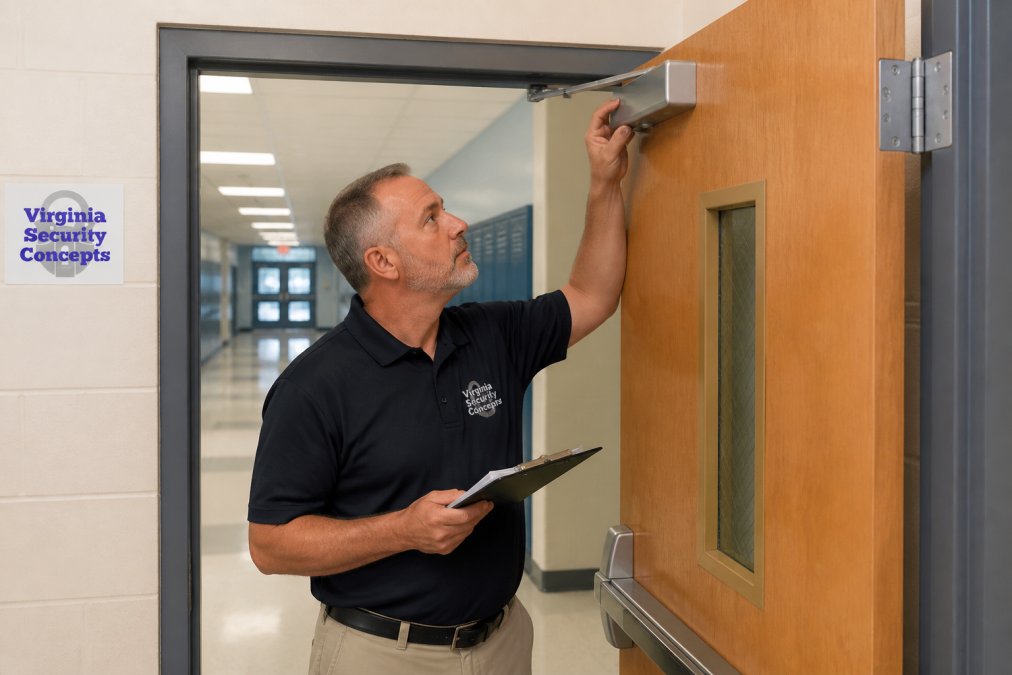
Inspections cover the door, frame, hardware, and closing mechanism. Common failures include damaged gaskets, painted-over labels, missing screws, and closers that no longer pull the door fully shut. Documentation matters as much as the inspection itself, because compliance is proven on paper. Administrators managing multiple buildings should confirm the firm can run audits at scale rather than one location at a time. The National Fire Protection Association's fire door safety resources explain why annual inspection and record-keeping are required.
Access Control Integration and Maintenance Contracts
Access control integration is where modern security consulting has moved furthest beyond lock-and-key thinking. Electronic strikes, keypad readers, and biometric scanners all need to work with your existing door hardware, and retrofitting them badly creates new vulnerabilities.
Ask any prospective consultant how they handle integration with the systems you already own. A firm that only installs standalone locks will leave you with a patchwork.
Approach | Best For | Trade-off |
Ad-hoc service calls | Single-site, low-traffic buildings | No baseline; problems recur |
Maintenance contract | Schools, churches, multi-tenant offices | Predictable cost, scheduled inspections |
Full integration | Facilities with access control systems | Higher upfront planning, fewer failures |
Maintenance contracts win for most institutions because they convert emergencies into scheduled checks. Vetting also matters: ask whether technicians undergo background checks, since they will access restricted areas. A written contract should spell out inspection frequency, response times, and warranty on parts.
Choosing a security consultant is a decision about trust, and trust is built on verified credentials, documented assessments, and honest estimates. Virginia Security Concepts was built for exactly this work: certified fire door inspections according to NFPA 80, thorough risk assessments that reveal hidden vulnerabilities, and a consultative approach to facility safety. Our technicians bring unmatched technical precision to every survey, and our clients tell us the difference shows in the details others miss. Book online with Virginia Security Concepts and get a security assessment you can actually rely on.
Frequently Asked Questions
What qualifications should a professional security consultant have?
Look for state licensing and liability insurance. A qualified security consultant should also have experience with NFPA 80 fire door inspection requirements and local building codes. Ask for proof of credentials and check references from similar facilities before hiring.
How do I verify the credentials of a physical security consultant?
Request copies of licenses, insurance certificates, and professional certifications. Contact the issuing bodies to confirm they are current. Check online reviews, ask for a physical office address, and request a written estimate. A legitimate security consultant will welcome these checks and provide documentation without hesitation.
What is the difference between a security consultant and a security guard service?
A security consultant assesses risks, designs security plans, and recommends improvements such as access control or master key systems. A guard service provides on-site personnel for monitoring and response. Consultants focus on strategy and compliance, while guards handle daily operations. Some projects need both, but the roles are distinct.
What should be included in a professional security risk assessment?
A thorough physical security risk assessment checklist should cover perimeter security, lighting, locks, access control, fire door compliance, and emergency response. It should also include a review of existing policies and a written report with prioritized recommendations. Ask for a sample report before hiring.
How much does a professional security consultation typically cost?
Pricing depends on the size of your property, the scope of the assessment, and whether you need ongoing maintenance. Request a written estimate that breaks down labor, parts, and any follow-up visits.
Book Online


Comments